



Our Guide to Cruising French Polynesia: The Society Islands, Motu Mahana and the Marquesas
Write a Review

Our Guide to Cruising French Polynesia: The Society Islands, Motu Mahana and the Marquesas
From UTM's archive: this is the author's account of a voyage aboard the Paul Gauguin, and the ship's itineraries, the Motu Mahana day and what is served there may have changed since.
It's a region that's inspired generations of artists and writers, and when you cruise French Polynesia's islands it's easy to see why. Perfect blue lagoons, colourful reefs, volcanic mountains, bright flowers and a real atmosphere of tranquillity combine to create one big natural watercolour that typifies the tropical idyll. French Polynesia, more popularly known as Tahiti and Her Islands, is divided into five separate archipelagos: the Society Islands, which include the main island of Tahiti and the administrative capital of Papeete, the Marquesas, the Tuamotus, and the remote and tiny Australs and Gambier Archipelago. Each group is unique, and all were formed by volcanic activity, creating mountainous islands and coral atolls, or reefs which are just above the water surface surrounded by a natural lagoon.
What makes Tahiti so famous
Overwater bungalows and five-star resorts are usually in focus when it comes to Tahiti, but there's a lot more to this stunning part of the Pacific than sipping cocktails under a palm tree by a pool. With 118 islands spread out over an area just a little smaller than Europe, Tahiti and Her Islands is arguably best experienced from the water, as this is truly one of the world's great maritime destinations. Some of the more remote islands are most easily reached by sea, and it was on these outer islands that we felt we saw a side of Tahiti the resorts don't show. It's not surprising that this part of the world attracted the attention of artists like Paul Gauguin. In addition to France's greatest post-impressionist painter, many other artists, explorers and writers made the arduous journey to French Polynesia, sometimes spending months at sea to answer its alluring call. From the time European adventurers and sailors returned with tales of a land, and people, of incredible beauty, Tahiti and Her Isles have been a real-life tropical fantasy for people around the world.
The Society Islands
It's just after 6pm and time for the nightly sunset show as the first tinge of yellow permeates the horizon. With the mythical peaks of Bora Bora as the backdrop, the show quickly moves into full swing. From yellow to orange, pink, red, blue, purple, and various outrageous hues in between, the multi-coloured palette moves through the sky and glassy ocean. With the sky ablaze, outrigger canoes paddle through the surreal scene, and out in the middle of one of the lagoons that ring the island, the jagged volcanic mountains on each side change colour with the sunset and finally darken against the night sky. The name Bora Bora has become synonymous with the word "paradise", and with its emerald-green hills and chameleon-like lagoons, it's easy to understand why it's a serious contender for the most beautiful and romantic island in the world. James Michener, author of Tales of the South Pacific, which inspired the musical South Pacific and its song "Bali Ha'i", wrote of Bora Bora: "Anyone who has ever been there wants to go back."
Bora Bora
Sailing into Bora Bora means navigating the one and only entry point through the reef surrounding the island, the Teavanui Pass, and it is one of those experiences which burns unforgettable images and emotions into the memory. Like many of the Tahitian islands, Bora Bora was created out of a volcano, and the jagged peaks which rise out of the ocean mark the edge of the original crater. On land, on our visit, this image of tropical perfection was somewhat diminished by rubbish-strewn roadsides and aloof locals, but these imperfections can be forgiven when Bora Bora is viewed from the deck of a ship. Although it's around 260 kilometres north-west of the main island of Tahiti, it's often the first stop for cruises in this region because of the "wow" factor that comes with circling Bora Bora before making the grand entrance into the lagoon.
Editor's update: Experiences and conditions vary; this passage reflects the author's impressions on that visit.
Moorea
But "The Magical Island" of Moorea is no less alluring. It's also been credited with inspiring the mythical Bali Ha'i, and appropriately, it's a heart-shaped island with a dramatic landscape which mirrors Bora Bora. Also a volcanic island, Moorea is a heady mix of mountains which often reach the clouds, tropical jungles, beautiful lagoons and the ocean, which forms a landscape of deep blue and green.
Unlike Bora Bora, however, there are several passes which allow ships to navigate past the reef which surrounds Moorea and sail into the turquoise lagoons. The Passe Teavaroa and Passe Tareu on the northern side of the island are the passes most used by cruise ships, and allow entry into Cook's Bay and Opunohu Bay. Cook's Bay is the most developed area of the island, with a string of hotels on the water alongside the main village of Paopao, but Opunohu Bay is arguably the most beautiful place on the island. It is much quieter, and it's been the setting for many films, including The Bounty, the 1984 retelling of the mutiny starring Anthony Hopkins and a young Mel Gibson. Quite simply, Opunohu Bay, and much of Moorea, possesses a powerful and natural beauty which even attracts Tahitians from other islands, and especially from the main island of Tahiti, as it's only a 20-kilometre ferry ride across the Sea of the Moon.
Ra'iatea and Taha'a
That's not to say the other Society Islands are unworthy of attention. The twin islands of Ra'iatea and Taha'a, which are separated by a three-kilometre channel and share a coral reef and a protected lagoon, are less touristy than Bora Bora and Moorea but have a more traditional Polynesian feel, with a laid-back atmosphere. Ra'iatea is known as The Sacred Island, as it was the centre of Tahitian royalty, religion and culture, and today its main attraction is the massive Taputapuātea marae, regarded as the largest and most sacred site in Polynesia. It's also one of several places to check out one of Tahiti's most prized souvenirs and famous exports, black pearls. Taha'a is the smaller of the twin islands and even quieter than Ra'iatea, but The Vanilla Island possesses a genuine village atmosphere, perhaps due in part to the fact that there's very little traffic. Its main claim to fame, however, is vanilla production, and a string of beautiful motu, uninhabited coral islets with stunning beaches, on its northern side.
Tahiti and Papeete
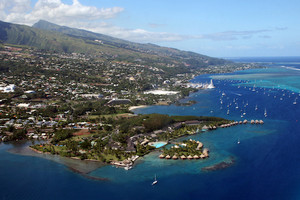
As for the main island, many visitors bypass Tahiti and its capital Papeete and simply connect to the outer islands, missing out on its many charms. For people cruising Tahiti, however, it's the key jumping-on and jumping-off destination, offering the opportunity to explore one of the country's best-kept secrets. From the street life of Papeete, to a four-wheel-drive tour of the interior with its cascading waterfalls and ancient marae, or archaeological sites, or simply catching some sun and snorkelling off the beaches at Punaauia, the main island possesses its own unique attractions. The municipal market in Papeete, Le Marché, features seemingly every fruit and vegetable from the islands on the ground floor, while the upper floor is dedicated to Tahitian arts and crafts. If given a chance, the main island can reveal a cultural side of its people and history that the glitzy resort islands don't offer. What it lacks in the classic-island-postcard stakes it makes up for with a very authentic French colonial charm.
Paradise rediscovered on Motu Mahana
One of the highlights of nearly every cruise on the Paul Gauguin in Tahiti is a day spent on Motu Mahana. It's a private island for cruise guests only, and this idyllic motu is flanked by Taha'a's mountains on one side and Bora Bora's cloud-piercing peaks on the other. Shimmering lagoon water laps gently against the edges of a pristine white beach dotted with teak deck chairs, umbrellas and hammocks strung between palm trees. The flowers are incredible: colourful sprays of bougainvillea spill over the trees and pathways, and tropical hibiscus with their pink and scarlet petals face up at the sun. The unavoidable lure of the warm, crystal-clear waters can turn even the most sedentary beach lover into a snorkeller or kayaker, and thanks to a floating bar, it's also possible to wallow in the balmy water sipping a piña colada made in a fresh coconut husk, while colourful fish dart in and about your feet.
The day on Motu Mahana is also the perfect opportunity to sample traditional Tahitian cuisine in a tropical paradise setting. From starters like poisson cru, which is tuna marinated in coconut milk and lime, to grilled local fish including mahi mahi, roast suckling pig, and side servings of yam and taro, it's a feast that defines the cuisine of the islands. Although the main ingredients are fairly basic, French and Chinese influences mean they can all be prepared in different styles, from fish or meat cooked in coconut milk, garlic or curry, to simple grills with tropical fruit on the side, and it shows that Tahitian cuisine has taken on an international flavour which is heavily influenced by the fresh produce unique to the region.
The Marquesas
As the Paul Gauguin cruises into Omoa Bay, the eerie sounds of conch shells and drums pounding out a driving rhythm increase in intensity. Volcanic cliffs almost one kilometre high drop straight into the ocean, and in between are deep gorges with lush jungle, and it's a surreal arrival into one of the most remote and unspoiled of the Tahitian Isles, Fatu Hiva. There are no airports, no jetties, no marinas, and a concrete slab at the end of the point on Omoa Bay is the only way on and off the island via an inflatable zodiac. On many days, big swells make it impossible to set foot on Fatu Hiva, and this fact in itself sums up the essence of the Marquesas. They don't get many visitors, and on the day we arrived a buzz went around the village, and people turned out in traditional dress to greet the new arrivals, beating drums and singing traditional songs. In the main square, local artisans set up and display their handmade creations, and it's easy to see why Marquesan handicrafts are regarded as among the most authentic and beautiful cultural creations in Polynesia. A traditional dance is performed, but this is not a "show" as performed by professional troupes in five-star resorts in the Society Islands. It's a show of village pride and an authentic snapshot of Marquesan culture.
Located nearly one and a half thousand kilometres north-east of the main island of Tahiti, the Marquesas' isolation means they are relatively untouched by tourism. On our visit, the villagers who showed us around Omoa seemed simply glad to share their way of life and their heritage. Of the 12 islands that make up the group, just six are inhabited, and only four have tiny airstrips, with infrequent flights. Around Omoa village, and in nearby Hanavave village, fruits grow wild by the roadside, and in between the houses are coconuts, breadfruit, local mountain apples, oranges, mangoes, papayas, bananas, avocados and Tahitian grapefruit, aka pamplemousse, which is twice as large as a normal grapefruit and much sweeter than most varieties. The breadfruit grows on trees up to 20 metres tall and is an important starch of the Marquesas which can be roasted, boiled or baked. The fishing boats bobbing next to the quay are evidence that seafood is also one of the staple foods for the locals, as are the children using bamboo poles and hand lines to catch fish, while further inland families cast nets to catch freshwater shrimp from rivers at the back of the valley.
The Marquesas possess a powerful and overwhelming physical presence, and sheer volcanic cliffs rise dramatically out of the Pacific Ocean. The jagged peaks rise side by side more than a kilometre up, creating plateaus at high altitude and steep valleys with lush vegetation which are home to wild horses and goats brought by European settlers. Most of the Marquesan islands feature a partly sunken caldera, which creates a natural amphitheatre among the towering mountains, and this is where the villagers choose to settle. The locals call their region Te Henua Enana, which means "the Land of Men", in reverence to their stunning backdrop. The history of Tahiti and Her Islands can also be traced back to the Marquesas, among the first islands of eastern Polynesia to be settled. The first Polynesians were long thought to have arrived around 300AD, although more recent research points to around 900 to 1000AD. Only a very jaded traveller wouldn't fall for French Polynesia's beauty and charm: the dramatic landscapes, the exotic flowers, the crystal-clear waters, and the sunsets which light up the sky and ocean in a 360-degree panorama of magnificent colours.
Gauguin's legacy
Many people have fallen for the extraordinary charms of Tahiti and Her Islands, and among the most famous is the legendary French artist Paul Gauguin. He arrived in Tahiti in 1891 financially ruined, in search of a new life, and determined to discover as much as he could about the Polynesian peoples and their culture. But the exotic idyll he'd imagined wasn't what he saw when he stepped off the steamer docked in Papeete. The Pacific island was a colony, with French officials and soldiers strutting around much the same as they did back home, two of the things from which he was trying to escape. In the years which followed, however, Gauguin painted what he saw or imagined the real Tahiti to be: well-rounded women wearing colourful pareu, or Tahitian sarongs, long-haired warriors riding bareback along the beaches, and locals washing horses in the foaming surf.
Although Gauguin lived on Tahiti for much of the 1890s, he spent his last years on the Marquesan island of Hiva Oa, one of the northernmost islands of French Polynesia, and died there in 1903. He is buried in Calvaire Cemetery, which is perched on top of a hill above Hiva Oa's main town of Atuona, overlooking the romantically named Bay of Traitors. Gauguin's grave is made of red sandstone and shaded by a frangipani tree, with one of Tahiti's legendary landscapes as a backdrop: jagged mountains draped in lush, green tropical foliage. Walking around the island, we found the Tahiti Gauguin depicted in such vivid colour and form still very much in view.
More from UTM: 20 Bucket-List Cruise Journeys and 10 Romantic Things to Do on a Cruise.
The islands are just as rewarding with your feet on the sand, and Pack Ya Bags can help Australian and New Zealand travellers plan guided tours and time on the ground across Tahiti and her islands, from Papeete's market to the marae of Ra'iatea. Write to info@packyabags.com to begin.
Editor's note. This article brings together UTM's original Our Guide to Cruising French Polynesia feature, first published in two parts, into a single piece. Consolidated and fact-checked on 22 September 2026.
- By:
- Joanna Hall