


Japan in Autumn: Koyo Timing, Region by Region, for Australian and New Zealand Travellers
Write a Review
Japan in Autumn: Koyo Timing, Region by Region, for Australian and New Zealand Travellers
There is an awkward shape to planning a Japanese autumn from Australia or New Zealand. The first national foliage outlook generally appears in September and is updated several times as autumn approaches, becoming more useful the closer it gets to the season. By the time it is precise, many travellers have already committed to accommodation for the peak weeks. Most of the planning therefore happens before the information exists.
The good news is that the season is knowable without it. Autumn colour in Japan is a front that moves, and it moves in a way that is consistent enough year to year to build an itinerary around.
What the season actually is
Japan’s autumn colour season runs from around late September into early December, depending on where you stand. It begins in the far north and at altitude, works south and downhill through October and November, and finishes in the south and in the lowland cities. That is a long season by any measure, and it is the single most useful fact in this article: no one week is the right week for Japan, because Japan does not have one autumn.
Broadly, and with the usual caveat that every year shifts:
- Hokkaido and the high mountains — generally the earliest, from around late September into October.
- Tohoku, Nikko and the Japanese Alps — through October and into the first part of November, with the higher ground turning well before the towns below. Around Nikko, for instance, the lakes and the alpine road colour noticeably before the town itself.
- Hakone, the Fuji Five Lakes and the mountain resorts within reach of Tokyo — generally into November.
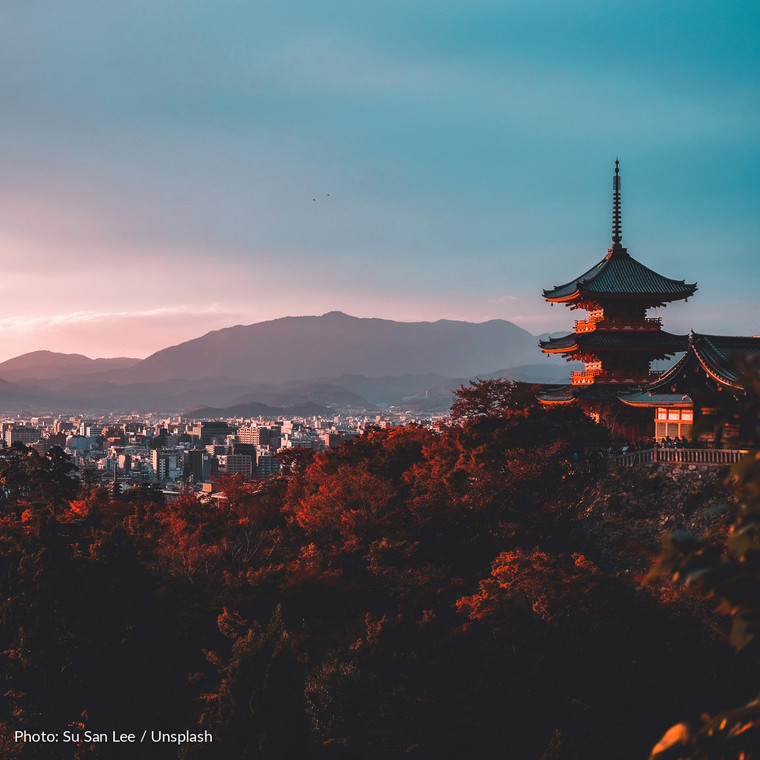
- Kyoto, Nara and Tokyo — generally from mid-November into early December, depending on the year and the location. Kyoto’s own tourism authority describes November as the city’s busiest month for visitors.
- Kyushu and the far south — the last to turn, generally later in November and into December, though parts of the far south have less of a traditional koyo season than Honshu does.
Altitude does as much work as latitude
This is the part most month-by-month guides leave out. The front comes down a mountain as much as it travels down the map. The alpine zone above a resort town can be finished while the town at the bottom of the same road has barely started, and both are in the same prefecture on the same day.
Two consequences follow. The first is that a single destination can be simultaneously too early and too late, depending on how high you stand in it, which means a day of vertical movement can rescue a week of bad timing. The second is that an itinerary built across two or three elevations is generally more robust than one built across two or three cities at the same height.
Why the forecast arrives after the decision
The Japanese forecasters generally publish a first national outlook in September and update it several times as autumn approaches. It is genuinely useful once it exists, particularly for fine-tuning which days go where. But the early forecasts are necessarily less precise than the updates issued closer to the season, by which point the most sought-after accommodation may already be committed.
The practical answer is to treat the forecast as a tuning instrument rather than a planning one. Build the itinerary on the regional pattern, which is stable, then use the forecast to decide the order of the last few days, which is where it earns its keep.
Colour depends on temperature. Warm autumns tend to push the front later; colder conditions can bring it forward. That is why the forecast becomes increasingly useful as the season approaches, and why the regional pattern rather than any single date is the sounder thing to design around.
What autumn is actually like on the ground
Comfortable for walking, and considerably more so than a Japanese summer, but the temperature range across the season is wide. Kyoto and Tokyo can be mild through November while Hokkaido and the mountain areas are already cold, and mornings and evenings run colder than the middle of the day everywhere. Layers rather than a single decision about a coat.
Daylight shortens noticeably through the season, which matters more than people expect when the itinerary includes gardens that close in the late afternoon. Against that, a number of temples and gardens open in the evening during the foliage weeks for illuminations, which effectively adds a second sightseeing window to the day — though these are seasonal and dated, some are ticketed separately and some use timed entry, so they are worth confirming rather than assuming.
Crowds are real at peak, and concentrated. The best-known sites in Kyoto in the second half of November are busy in a way that changes the experience, and weekends can be substantially busier than weekdays. An early start makes a larger difference here than almost anywhere else in Japan.
How to build an itinerary that meets the colour
Where the dates allow, run the trip in roughly the same direction as the season: north and high first, south and low last. A fortnight that starts in the mountains in the first half of November and finishes in Kyoto at the end of it is following the front rather than gambling against it, and it gives the trip two or three separate chances at peak colour instead of one. A trip that can only travel late in the season is a different problem, and is usually better built around the cities and the lower ground than around the mountains.
Two things make that work in practice. Book the fixed points first — the Kyoto nights in particular, because they are the scarcest and the hardest to change. Then, where practical, keep a little flexibility toward the end of the trip, so the itinerary can move if the season runs late. The order matters: flexibility is worth having, but not at the cost of the accommodation that is difficult to secure at all.
The season after this one
There is a second reason autumn is a useful moment to be planning. Cherry blossom is less forgiving at the destination level: the peak window in any one city can be very short, the first forecasts do not appear until early in the year, and the dates move between years. Koyo gives you more ways to chase the season, across both latitude and elevation. Anyone considering blossom for the following spring is making that decision on a shorter margin than a koyo trip ever demands.
The two seasons are usually presented as alternatives. In planning terms they are more usefully thought of as the same problem at two different difficulty settings — and autumn is the forgiving one.
Practical points worth confirming
- Peak foliage weekends can be among the busiest travel periods of the year, particularly in Kyoto and the other major viewing destinations. Reserve popular trains and other fixed transport rather than assuming seats will be available together.
- Evening illuminations are seasonal and dated, and many require a separate ticket or timed entry. Confirm before building an evening around one.
- Autumn is one of Japan’s great seasonal food periods, and menus change with it — worth flagging to anyone who cares about eating well, because the difference is noticeable.
- Mountain and alpine areas can have seasonal road, ropeway and accommodation closures as winter approaches, and the dates vary by destination. Check the tail end of any high-altitude itinerary.
If you are planning a koyo trip
The first national foliage outlook is due in September and will be revised several times before the leaves turn. If you already have an autumn itinerary sketched out, we are happy to read the forecast against it once it lands and tell you where the order of the days should change — or, if you are starting from nothing, to build it around the regional pattern first and tune it later. Either way, write to info@packyabags.com and one of our planners will come back to you.
- By:
- David Chandraraj
- Published:
- 1 September 2026